


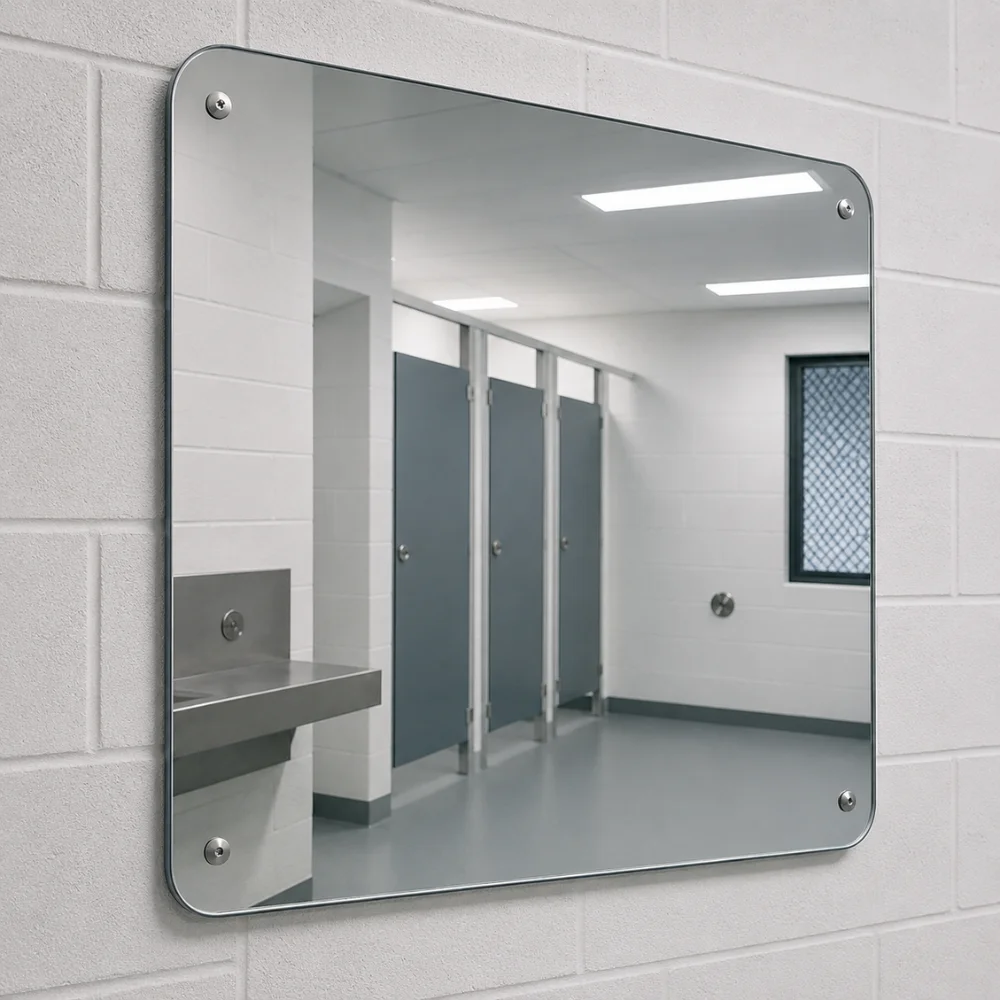
*Please note: Images are for illustrative purposes only. Actual colors, finishes, and product packaging may vary slightly from what appears online.
Abrasion Resistant Polycarbonate Mirror
Abrasion-Resistant Polycarbonate Mirror combines a high-impact polycarbonate substrate with a durable hard-coated reflective surface. It provides clear, glass-like reflection while offering significantly greater resistance to impact, scratching, vandalism and breakage than conventional glass or acrylic mirrors.
It is designed for high-risk, high-traffic and demanding environments where safety, durability and long-term optical performance are essential.
Contact us for pricing
Description
Product Description
Abrasion-Resistant Polycarbonate Mirror is a specialist safety mirror manufactured using a high-strength polycarbonate core, an optical reflective layer and a protective abrasion-resistant hard coating.
Unlike standard glass mirrors, polycarbonate mirror does not break into dangerous sharp fragments when impacted. The hard-coated surface provides improved resistance to scratches, routine cleaning, chemicals and environmental wear compared with standard uncoated plastic mirrors.
Its lightweight construction also makes it easier to handle and install than glass. With appropriate framing, security fixings and sealed-edge options, it can be specified for correctional facilities, mental-health environments, public amenities, recreational facilities and other areas exposed to impact, moisture or vandalism.
UV-stabilised options may also be available for damp, wet or outdoor-exposed installations.
Key Features
- High-impact polycarbonate construction
- Abrasion-resistant hard-coated surface
- Clear, glass-like reflective appearance
- Shatter-safe alternative to conventional glass mirrors
- Improved scratch resistance compared with standard acrylic and uncoated polycarbonate mirrors
- Resistant to repeated impact, abuse and vandalism
- Lightweight and easier to handle than glass
- Improved resistance to common cleaning agents, mild detergents and approved disinfectants
- Suitable for high-traffic and high-risk environments
- Helps reduce mirror replacement, maintenance and downtime costs
- Can be cut to size and CNC-machined into custom shapes
- Available with rounded corners, apertures, edge trims and security-fixing systems
- Can be incorporated into anti-ligature or tamper-resistant framed assemblies
- UV-stabilised and sealed-edge options may be available for wet or outdoor areas
- Optional sacrificial anti-graffiti protection film can be applied in severe vandalism environments
Applications
- Correctional facilities and prison cells
- Police stations and detention centres
- Mental-health facilities
- Seclusion and patient observation rooms
- Hospitals and healthcare facilities
- Secure accommodation
- Schools and educational facilities
- Public toilets and change rooms
- Swimming pools and aquatic centres
- Gymnasiums and recreational facilities
- Sporting stadiums
- Transport stations and terminals
- Public buildings
- Shopping centres and retail environments
- Traffic observation mirrors
- Driveway and blind-corner safety mirrors
- Anti-vandal mirror installations
- High-traffic commercial washrooms
- Industrial and workplace safety mirrors
Custom Fabrication
Abrasion-Resistant Polycarbonate Mirror can be supplied cut to size or fabricated to suit project-specific requirements. Available fabrication options may include CNC profiling, rounded corners, chamfered edges, openings, cut-outs, aluminium edge trims, security fixings and custom mounting systems.
For high-risk mental-health and correctional applications, the mirror should be installed using an appropriately designed anti-ligature or tamper-resistant mounting system selected for the site’s risk classification.
Cleaning and Maintenance
Remove loose dust or grit before cleaning. Wash the mirror using mild soapy water or an approved plastic cleaner and a soft microfibre cloth. Rinse with clean water and gently pat dry.
Avoid abrasive pads, dry wiping, strong alkaline cleaners, aromatic solvents and ketone-based chemicals. Cleaner compatibility should be confirmed before use, particularly in healthcare and institutional environments.
Frequently Asked Questions
Find answers to common questions about Abrasion-Resistant Polycarbonate Mirror, including its construction, impact resistance, installation, anti-ligature applications, mounting options, cleaning and suitable environments.
An abrasion-resistant polycarbonate mirror is a lightweight safety mirror manufactured from high-quality polycarbonate rather than glass. It combines the exceptional impact resistance of polycarbonate with a reflective mirror finish and a hard-coated viewing surface.
The abrasion-resistant coating improves protection against scratching, staining, cleaning chemicals and everyday wear. However, the surface is scratch-resistant—not completely scratch-proof.
The manufacturing process begins with an optical-grade polycarbonate sheet. A reflective mirror layer is applied using a vacuum-metalising process, followed by a durable protective coating over the back of the mirror. A specialised abrasion-resistant hard coating is applied to the viewing surface to improve scratch, stain and solvent resistance.
This construction provides a clear reflective surface while retaining the lightweight and high-impact characteristics of polycarbonate.
It is more accurate to describe polycarbonate mirror as virtually unbreakable or highly break-resistant. Plaskolite states that its mirrored polycarbonate is approximately 20 times more break-resistant than glass of the same thickness.
Unlike conventional glass mirror, polycarbonate does not readily shatter into dangerous fragments. However, no material should be represented as impossible to damage. Performance depends on the mirror thickness, size, mounting method, supporting surface and conditions of use.
No. Polycarbonate mirror sheet is highly impact-resistant, but the sheet by itself is not automatically an anti-ligature product.
Anti-ligature performance is achieved through the complete mirror assembly and installation. This may include a rigid backing, close-fitting or enclosed edges, concealed or tamper-resistant fixings and compatible anti-pick silicone around the perimeter. The finished installation must be assessed against the facility’s design brief, risk assessment and project specifications.
Abrasion-resistant polycarbonate mirror is suitable for areas where broken glass, vandalism, repeated cleaning or personal safety may be a concern. Common applications include:
- Prisons, correctional facilities and detention centres
- Police stations, court holding cells and secure interview rooms
- Mental-health facilities and behavioural-health units
- Secure hospital rooms, bathrooms and patient ensuites
- Public toilets, change rooms and aquatic facilities
- Schools, universities and sporting facilities
- Transport facilities and aircraft bathrooms
- High-traffic and vandal-prone public areas
- Retail displays, partitions, doors and furnishings
Plaskolite specifically recommends polycarbonate mirror for applications including mental-health facilities, detention centres and aircraft bathrooms. Product selection and installation must still be confirmed for each project.
Yes. Altius Polymers can fabricate abrasion-resistant polycarbonate mirror into custom safety-mirror systems, including:
- A framed anti-ligature version with securely enclosed edges and tamper-resistant or concealed fixings
- A direct-mount version designed to be bonded or mechanically fixed to a suitable solid backing
Where required, perimeter gaps can be sealed using compatible anti-pick silicone to restrict access behind the mirror. The appropriate design will depend on the facility’s risk level, wall construction, moisture exposure and installation requirements.
The mirror should be installed against a smooth, rigid and completely flat surface. Use only the adhesive system specified or approved for the supplied mirror. This may include a proprietary mirror-compatible silicone, mastic, mounting tape or compatible contact adhesive that will not react with the mirror’s protective back coating.
Generic construction adhesives, silicones and contact adhesives should not be used without checking compatibility. Plaskolite warns that some solvent-containing adhesives can attack the back coating and recommends testing the proposed adhesive on an offcut for at least 72 hours before installation.
Mechanical fixing is also possible, but holes should allow for material movement and fasteners must not be overtightened, as this can create dimpling and image distortion. Anti-ligature installations should always follow the approved project fixing detail.
Yes. Polycarbonate mirror can be bonded or laminated onto moisture-resistant MDF, plywood or another suitable solid backing. For the best reflection, the supporting surface must be smooth, rigid, dry and completely flat.
Plaskolite recommends mounting its mirror sheet onto a rigid backing such as 12.7 mm MDF or 6.35 mm hardboard. Suitable MR MDF or high-quality plywood may also be used, provided it is properly sealed and does not contain surface irregularities.
A solid backing supports the mirror evenly and helps prevent rippling, bowing and visual distortion. Any grain, joints, fasteners or uneven areas in the backing may become visible in the reflected image.
Some minor distortion can occur because polycarbonate is lighter and more flexible than glass. Distortion is more noticeable when a thin or large mirror is installed over an uneven wall or when adhesive is applied inconsistently.
Using an appropriate mirror thickness and laminating it uniformly onto a smooth, rigid and flat substrate will significantly improve the reflected image. However, plastic mirror should not be selected where laboratory-grade or precision reflection is required.
Clean the mirror using mild soap, clean water and a soft damp cloth or microfibre cloth. Avoid abrasive pads, scouring compounds, household glass cleaners and strong solvents.
Do not expose the protective rear coating to cleaning chemicals. Although the viewing surface has an abrasion-resistant hard coating, careful cleaning will help maintain its reflective quality and service life.
Product Description
Abrasion-Resistant Polycarbonate Mirror is a specialist safety mirror manufactured using a high-strength polycarbonate core, an optical reflective layer and a protective abrasion-resistant hard coating.
Unlike standard glass mirrors, polycarbonate mirror does not break into dangerous sharp fragments when impacted. The hard-coated surface provides improved resistance to scratches, routine cleaning, chemicals and environmental wear compared with standard uncoated plastic mirrors.
Its lightweight construction also makes it easier to handle and install than glass. With appropriate framing, security fixings and sealed-edge options, it can be specified for correctional facilities, mental-health environments, public amenities, recreational facilities and other areas exposed to impact, moisture or vandalism.
UV-stabilised options may also be available for damp, wet or outdoor-exposed installations.
Key Features
- High-impact polycarbonate construction
- Abrasion-resistant hard-coated surface
- Clear, glass-like reflective appearance
- Shatter-safe alternative to conventional glass mirrors
- Improved scratch resistance compared with standard acrylic and uncoated polycarbonate mirrors
- Resistant to repeated impact, abuse and vandalism
- Lightweight and easier to handle than glass
- Improved resistance to common cleaning agents, mild detergents and approved disinfectants
- Suitable for high-traffic and high-risk environments
- Helps reduce mirror replacement, maintenance and downtime costs
- Can be cut to size and CNC-machined into custom shapes
- Available with rounded corners, apertures, edge trims and security-fixing systems
- Can be incorporated into anti-ligature or tamper-resistant framed assemblies
- UV-stabilised and sealed-edge options may be available for wet or outdoor areas
- Optional sacrificial anti-graffiti protection film can be applied in severe vandalism environments
Applications
- Correctional facilities and prison cells
- Police stations and detention centres
- Mental-health facilities
- Seclusion and patient observation rooms
- Hospitals and healthcare facilities
- Secure accommodation
- Schools and educational facilities
- Public toilets and change rooms
- Swimming pools and aquatic centres
- Gymnasiums and recreational facilities
- Sporting stadiums
- Transport stations and terminals
- Public buildings
- Shopping centres and retail environments
- Traffic observation mirrors
- Driveway and blind-corner safety mirrors
- Anti-vandal mirror installations
- High-traffic commercial washrooms
- Industrial and workplace safety mirrors
Custom Fabrication
Abrasion-Resistant Polycarbonate Mirror can be supplied cut to size or fabricated to suit project-specific requirements. Available fabrication options may include CNC profiling, rounded corners, chamfered edges, openings, cut-outs, aluminium edge trims, security fixings and custom mounting systems.
For high-risk mental-health and correctional applications, the mirror should be installed using an appropriately designed anti-ligature or tamper-resistant mounting system selected for the site’s risk classification.
Cleaning and Maintenance
Remove loose dust or grit before cleaning. Wash the mirror using mild soapy water or an approved plastic cleaner and a soft microfibre cloth. Rinse with clean water and gently pat dry.
Avoid abrasive pads, dry wiping, strong alkaline cleaners, aromatic solvents and ketone-based chemicals. Cleaner compatibility should be confirmed before use, particularly in healthcare and institutional environments.
Frequently Asked Questions
Find answers to common questions about Abrasion-Resistant Polycarbonate Mirror, including its construction, impact resistance, installation, anti-ligature applications, mounting options, cleaning and suitable environments.
An abrasion-resistant polycarbonate mirror is a lightweight safety mirror manufactured from high-quality polycarbonate rather than glass. It combines the exceptional impact resistance of polycarbonate with a reflective mirror finish and a hard-coated viewing surface.
The abrasion-resistant coating improves protection against scratching, staining, cleaning chemicals and everyday wear. However, the surface is scratch-resistant—not completely scratch-proof.
The manufacturing process begins with an optical-grade polycarbonate sheet. A reflective mirror layer is applied using a vacuum-metalising process, followed by a durable protective coating over the back of the mirror. A specialised abrasion-resistant hard coating is applied to the viewing surface to improve scratch, stain and solvent resistance.
This construction provides a clear reflective surface while retaining the lightweight and high-impact characteristics of polycarbonate.
It is more accurate to describe polycarbonate mirror as virtually unbreakable or highly break-resistant. Plaskolite states that its mirrored polycarbonate is approximately 20 times more break-resistant than glass of the same thickness.
Unlike conventional glass mirror, polycarbonate does not readily shatter into dangerous fragments. However, no material should be represented as impossible to damage. Performance depends on the mirror thickness, size, mounting method, supporting surface and conditions of use.
No. Polycarbonate mirror sheet is highly impact-resistant, but the sheet by itself is not automatically an anti-ligature product.
Anti-ligature performance is achieved through the complete mirror assembly and installation. This may include a rigid backing, close-fitting or enclosed edges, concealed or tamper-resistant fixings and compatible anti-pick silicone around the perimeter. The finished installation must be assessed against the facility’s design brief, risk assessment and project specifications.
Abrasion-resistant polycarbonate mirror is suitable for areas where broken glass, vandalism, repeated cleaning or personal safety may be a concern. Common applications include:
- Prisons, correctional facilities and detention centres
- Police stations, court holding cells and secure interview rooms
- Mental-health facilities and behavioural-health units
- Secure hospital rooms, bathrooms and patient ensuites
- Public toilets, change rooms and aquatic facilities
- Schools, universities and sporting facilities
- Transport facilities and aircraft bathrooms
- High-traffic and vandal-prone public areas
- Retail displays, partitions, doors and furnishings
Plaskolite specifically recommends polycarbonate mirror for applications including mental-health facilities, detention centres and aircraft bathrooms. Product selection and installation must still be confirmed for each project.
Yes. Altius Polymers can fabricate abrasion-resistant polycarbonate mirror into custom safety-mirror systems, including:
- A framed anti-ligature version with securely enclosed edges and tamper-resistant or concealed fixings
- A direct-mount version designed to be bonded or mechanically fixed to a suitable solid backing
Where required, perimeter gaps can be sealed using compatible anti-pick silicone to restrict access behind the mirror. The appropriate design will depend on the facility’s risk level, wall construction, moisture exposure and installation requirements.
The mirror should be installed against a smooth, rigid and completely flat surface. Use only the adhesive system specified or approved for the supplied mirror. This may include a proprietary mirror-compatible silicone, mastic, mounting tape or compatible contact adhesive that will not react with the mirror’s protective back coating.
Generic construction adhesives, silicones and contact adhesives should not be used without checking compatibility. Plaskolite warns that some solvent-containing adhesives can attack the back coating and recommends testing the proposed adhesive on an offcut for at least 72 hours before installation.
Mechanical fixing is also possible, but holes should allow for material movement and fasteners must not be overtightened, as this can create dimpling and image distortion. Anti-ligature installations should always follow the approved project fixing detail.
Yes. Polycarbonate mirror can be bonded or laminated onto moisture-resistant MDF, plywood or another suitable solid backing. For the best reflection, the supporting surface must be smooth, rigid, dry and completely flat.
Plaskolite recommends mounting its mirror sheet onto a rigid backing such as 12.7 mm MDF or 6.35 mm hardboard. Suitable MR MDF or high-quality plywood may also be used, provided it is properly sealed and does not contain surface irregularities.
A solid backing supports the mirror evenly and helps prevent rippling, bowing and visual distortion. Any grain, joints, fasteners or uneven areas in the backing may become visible in the reflected image.
Some minor distortion can occur because polycarbonate is lighter and more flexible than glass. Distortion is more noticeable when a thin or large mirror is installed over an uneven wall or when adhesive is applied inconsistently.
Using an appropriate mirror thickness and laminating it uniformly onto a smooth, rigid and flat substrate will significantly improve the reflected image. However, plastic mirror should not be selected where laboratory-grade or precision reflection is required.
Clean the mirror using mild soap, clean water and a soft damp cloth or microfibre cloth. Avoid abrasive pads, scouring compounds, household glass cleaners and strong solvents.
Do not expose the protective rear coating to cleaning chemicals. Although the viewing surface has an abrasion-resistant hard coating, careful cleaning will help maintain its reflective quality and service life.
 Overview
Specification
Overview
Description
Product Description
Abrasion-Resistant Polycarbonate Mirror is a specialist safety mirror manufactured using a high-strength polycarbonate core, an optical reflective layer and a protective abrasion-resistant hard coating.
Unlike standard glass mirrors, polycarbonate mirror does not break into dangerous sharp fragments when impacted. The hard-coated surface provides improved resistance to scratches, routine cleaning, chemicals and environmental wear compared with standard uncoated plastic mirrors.
Its lightweight construction also makes it easier to handle and install than glass. With appropriate framing, security fixings and sealed-edge options, it can be specified for correctional facilities, mental-health environments, public amenities, recreational facilities and other areas exposed to impact, moisture or vandalism.
UV-stabilised options may also be available for damp, wet or outdoor-exposed installations.
Key Features
- High-impact polycarbonate construction
- Abrasion-resistant hard-coated surface
- Clear, glass-like reflective appearance
- Shatter-safe alternative to conventional glass mirrors
- Improved scratch resistance compared with standard acrylic and uncoated polycarbonate mirrors
- Resistant to repeated impact, abuse and vandalism
- Lightweight and easier to handle than glass
- Improved resistance to common cleaning agents, mild detergents and approved disinfectants
- Suitable for high-traffic and high-risk environments
- Helps reduce mirror replacement, maintenance and downtime costs
- Can be cut to size and CNC-machined into custom shapes
- Available with rounded corners, apertures, edge trims and security-fixing systems
- Can be incorporated into anti-ligature or tamper-resistant framed assemblies
- UV-stabilised and sealed-edge options may be available for wet or outdoor areas
- Optional sacrificial anti-graffiti protection film can be applied in severe vandalism environments
Applications
- Correctional facilities and prison cells
- Police stations and detention centres
- Mental-health facilities
- Seclusion and patient observation rooms
- Hospitals and healthcare facilities
- Secure accommodation
- Schools and educational facilities
- Public toilets and change rooms
- Swimming pools and aquatic centres
- Gymnasiums and recreational facilities
- Sporting stadiums
- Transport stations and terminals
- Public buildings
- Shopping centres and retail environments
- Traffic observation mirrors
- Driveway and blind-corner safety mirrors
- Anti-vandal mirror installations
- High-traffic commercial washrooms
- Industrial and workplace safety mirrors
Custom Fabrication
Abrasion-Resistant Polycarbonate Mirror can be supplied cut to size or fabricated to suit project-specific requirements. Available fabrication options may include CNC profiling, rounded corners, chamfered edges, openings, cut-outs, aluminium edge trims, security fixings and custom mounting systems.
For high-risk mental-health and correctional applications, the mirror should be installed using an appropriately designed anti-ligature or tamper-resistant mounting system selected for the site’s risk classification.
Cleaning and Maintenance
Remove loose dust or grit before cleaning. Wash the mirror using mild soapy water or an approved plastic cleaner and a soft microfibre cloth. Rinse with clean water and gently pat dry.
Avoid abrasive pads, dry wiping, strong alkaline cleaners, aromatic solvents and ketone-based chemicals. Cleaner compatibility should be confirmed before use, particularly in healthcare and institutional environments.
Frequently Asked Questions
Find answers to common questions about Abrasion-Resistant Polycarbonate Mirror, including its construction, impact resistance, installation, anti-ligature applications, mounting options, cleaning and suitable environments.
An abrasion-resistant polycarbonate mirror is a lightweight safety mirror manufactured from high-quality polycarbonate rather than glass. It combines the exceptional impact resistance of polycarbonate with a reflective mirror finish and a hard-coated viewing surface.
The abrasion-resistant coating improves protection against scratching, staining, cleaning chemicals and everyday wear. However, the surface is scratch-resistant—not completely scratch-proof.
The manufacturing process begins with an optical-grade polycarbonate sheet. A reflective mirror layer is applied using a vacuum-metalising process, followed by a durable protective coating over the back of the mirror. A specialised abrasion-resistant hard coating is applied to the viewing surface to improve scratch, stain and solvent resistance.
This construction provides a clear reflective surface while retaining the lightweight and high-impact characteristics of polycarbonate.
It is more accurate to describe polycarbonate mirror as virtually unbreakable or highly break-resistant. Plaskolite states that its mirrored polycarbonate is approximately 20 times more break-resistant than glass of the same thickness.
Unlike conventional glass mirror, polycarbonate does not readily shatter into dangerous fragments. However, no material should be represented as impossible to damage. Performance depends on the mirror thickness, size, mounting method, supporting surface and conditions of use.
No. Polycarbonate mirror sheet is highly impact-resistant, but the sheet by itself is not automatically an anti-ligature product.
Anti-ligature performance is achieved through the complete mirror assembly and installation. This may include a rigid backing, close-fitting or enclosed edges, concealed or tamper-resistant fixings and compatible anti-pick silicone around the perimeter. The finished installation must be assessed against the facility’s design brief, risk assessment and project specifications.
Abrasion-resistant polycarbonate mirror is suitable for areas where broken glass, vandalism, repeated cleaning or personal safety may be a concern. Common applications include:
- Prisons, correctional facilities and detention centres
- Police stations, court holding cells and secure interview rooms
- Mental-health facilities and behavioural-health units
- Secure hospital rooms, bathrooms and patient ensuites
- Public toilets, change rooms and aquatic facilities
- Schools, universities and sporting facilities
- Transport facilities and aircraft bathrooms
- High-traffic and vandal-prone public areas
- Retail displays, partitions, doors and furnishings
Plaskolite specifically recommends polycarbonate mirror for applications including mental-health facilities, detention centres and aircraft bathrooms. Product selection and installation must still be confirmed for each project.
Yes. Altius Polymers can fabricate abrasion-resistant polycarbonate mirror into custom safety-mirror systems, including:
- A framed anti-ligature version with securely enclosed edges and tamper-resistant or concealed fixings
- A direct-mount version designed to be bonded or mechanically fixed to a suitable solid backing
Where required, perimeter gaps can be sealed using compatible anti-pick silicone to restrict access behind the mirror. The appropriate design will depend on the facility’s risk level, wall construction, moisture exposure and installation requirements.
The mirror should be installed against a smooth, rigid and completely flat surface. Use only the adhesive system specified or approved for the supplied mirror. This may include a proprietary mirror-compatible silicone, mastic, mounting tape or compatible contact adhesive that will not react with the mirror’s protective back coating.
Generic construction adhesives, silicones and contact adhesives should not be used without checking compatibility. Plaskolite warns that some solvent-containing adhesives can attack the back coating and recommends testing the proposed adhesive on an offcut for at least 72 hours before installation.
Mechanical fixing is also possible, but holes should allow for material movement and fasteners must not be overtightened, as this can create dimpling and image distortion. Anti-ligature installations should always follow the approved project fixing detail.
Yes. Polycarbonate mirror can be bonded or laminated onto moisture-resistant MDF, plywood or another suitable solid backing. For the best reflection, the supporting surface must be smooth, rigid, dry and completely flat.
Plaskolite recommends mounting its mirror sheet onto a rigid backing such as 12.7 mm MDF or 6.35 mm hardboard. Suitable MR MDF or high-quality plywood may also be used, provided it is properly sealed and does not contain surface irregularities.
A solid backing supports the mirror evenly and helps prevent rippling, bowing and visual distortion. Any grain, joints, fasteners or uneven areas in the backing may become visible in the reflected image.
Some minor distortion can occur because polycarbonate is lighter and more flexible than glass. Distortion is more noticeable when a thin or large mirror is installed over an uneven wall or when adhesive is applied inconsistently.
Using an appropriate mirror thickness and laminating it uniformly onto a smooth, rigid and flat substrate will significantly improve the reflected image. However, plastic mirror should not be selected where laboratory-grade or precision reflection is required.
Clean the mirror using mild soap, clean water and a soft damp cloth or microfibre cloth. Avoid abrasive pads, scouring compounds, household glass cleaners and strong solvents.
Do not expose the protective rear coating to cleaning chemicals. Although the viewing surface has an abrasion-resistant hard coating, careful cleaning will help maintain its reflective quality and service life.
Review
Specification
Overview
 Processor
 Display
 RAM
RAM
Description
Product Description
Abrasion-Resistant Polycarbonate Mirror is a specialist safety mirror manufactured using a high-strength polycarbonate core, an optical reflective layer and a protective abrasion-resistant hard coating.
Unlike standard glass mirrors, polycarbonate mirror does not break into dangerous sharp fragments when impacted. The hard-coated surface provides improved resistance to scratches, routine cleaning, chemicals and environmental wear compared with standard uncoated plastic mirrors.
Its lightweight construction also makes it easier to handle and install than glass. With appropriate framing, security fixings and sealed-edge options, it can be specified for correctional facilities, mental-health environments, public amenities, recreational facilities and other areas exposed to impact, moisture or vandalism.
UV-stabilised options may also be available for damp, wet or outdoor-exposed installations.
Key Features
- High-impact polycarbonate construction
- Abrasion-resistant hard-coated surface
- Clear, glass-like reflective appearance
- Shatter-safe alternative to conventional glass mirrors
- Improved scratch resistance compared with standard acrylic and uncoated polycarbonate mirrors
- Resistant to repeated impact, abuse and vandalism
- Lightweight and easier to handle than glass
- Improved resistance to common cleaning agents, mild detergents and approved disinfectants
- Suitable for high-traffic and high-risk environments
- Helps reduce mirror replacement, maintenance and downtime costs
- Can be cut to size and CNC-machined into custom shapes
- Available with rounded corners, apertures, edge trims and security-fixing systems
- Can be incorporated into anti-ligature or tamper-resistant framed assemblies
- UV-stabilised and sealed-edge options may be available for wet or outdoor areas
- Optional sacrificial anti-graffiti protection film can be applied in severe vandalism environments
Applications
- Correctional facilities and prison cells
- Police stations and detention centres
- Mental-health facilities
- Seclusion and patient observation rooms
- Hospitals and healthcare facilities
- Secure accommodation
- Schools and educational facilities
- Public toilets and change rooms
- Swimming pools and aquatic centres
- Gymnasiums and recreational facilities
- Sporting stadiums
- Transport stations and terminals
- Public buildings
- Shopping centres and retail environments
- Traffic observation mirrors
- Driveway and blind-corner safety mirrors
- Anti-vandal mirror installations
- High-traffic commercial washrooms
- Industrial and workplace safety mirrors
Custom Fabrication
Abrasion-Resistant Polycarbonate Mirror can be supplied cut to size or fabricated to suit project-specific requirements. Available fabrication options may include CNC profiling, rounded corners, chamfered edges, openings, cut-outs, aluminium edge trims, security fixings and custom mounting systems.
For high-risk mental-health and correctional applications, the mirror should be installed using an appropriately designed anti-ligature or tamper-resistant mounting system selected for the site’s risk classification.
Cleaning and Maintenance
Remove loose dust or grit before cleaning. Wash the mirror using mild soapy water or an approved plastic cleaner and a soft microfibre cloth. Rinse with clean water and gently pat dry.
Avoid abrasive pads, dry wiping, strong alkaline cleaners, aromatic solvents and ketone-based chemicals. Cleaner compatibility should be confirmed before use, particularly in healthcare and institutional environments.
Frequently Asked Questions
Find answers to common questions about Abrasion-Resistant Polycarbonate Mirror, including its construction, impact resistance, installation, anti-ligature applications, mounting options, cleaning and suitable environments.
An abrasion-resistant polycarbonate mirror is a lightweight safety mirror manufactured from high-quality polycarbonate rather than glass. It combines the exceptional impact resistance of polycarbonate with a reflective mirror finish and a hard-coated viewing surface.
The abrasion-resistant coating improves protection against scratching, staining, cleaning chemicals and everyday wear. However, the surface is scratch-resistant—not completely scratch-proof.
The manufacturing process begins with an optical-grade polycarbonate sheet. A reflective mirror layer is applied using a vacuum-metalising process, followed by a durable protective coating over the back of the mirror. A specialised abrasion-resistant hard coating is applied to the viewing surface to improve scratch, stain and solvent resistance.
This construction provides a clear reflective surface while retaining the lightweight and high-impact characteristics of polycarbonate.
It is more accurate to describe polycarbonate mirror as virtually unbreakable or highly break-resistant. Plaskolite states that its mirrored polycarbonate is approximately 20 times more break-resistant than glass of the same thickness.
Unlike conventional glass mirror, polycarbonate does not readily shatter into dangerous fragments. However, no material should be represented as impossible to damage. Performance depends on the mirror thickness, size, mounting method, supporting surface and conditions of use.
No. Polycarbonate mirror sheet is highly impact-resistant, but the sheet by itself is not automatically an anti-ligature product.
Anti-ligature performance is achieved through the complete mirror assembly and installation. This may include a rigid backing, close-fitting or enclosed edges, concealed or tamper-resistant fixings and compatible anti-pick silicone around the perimeter. The finished installation must be assessed against the facility’s design brief, risk assessment and project specifications.
Abrasion-resistant polycarbonate mirror is suitable for areas where broken glass, vandalism, repeated cleaning or personal safety may be a concern. Common applications include:
- Prisons, correctional facilities and detention centres
- Police stations, court holding cells and secure interview rooms
- Mental-health facilities and behavioural-health units
- Secure hospital rooms, bathrooms and patient ensuites
- Public toilets, change rooms and aquatic facilities
- Schools, universities and sporting facilities
- Transport facilities and aircraft bathrooms
- High-traffic and vandal-prone public areas
- Retail displays, partitions, doors and furnishings
Plaskolite specifically recommends polycarbonate mirror for applications including mental-health facilities, detention centres and aircraft bathrooms. Product selection and installation must still be confirmed for each project.
Yes. Altius Polymers can fabricate abrasion-resistant polycarbonate mirror into custom safety-mirror systems, including:
- A framed anti-ligature version with securely enclosed edges and tamper-resistant or concealed fixings
- A direct-mount version designed to be bonded or mechanically fixed to a suitable solid backing
Where required, perimeter gaps can be sealed using compatible anti-pick silicone to restrict access behind the mirror. The appropriate design will depend on the facility’s risk level, wall construction, moisture exposure and installation requirements.
The mirror should be installed against a smooth, rigid and completely flat surface. Use only the adhesive system specified or approved for the supplied mirror. This may include a proprietary mirror-compatible silicone, mastic, mounting tape or compatible contact adhesive that will not react with the mirror’s protective back coating.
Generic construction adhesives, silicones and contact adhesives should not be used without checking compatibility. Plaskolite warns that some solvent-containing adhesives can attack the back coating and recommends testing the proposed adhesive on an offcut for at least 72 hours before installation.
Mechanical fixing is also possible, but holes should allow for material movement and fasteners must not be overtightened, as this can create dimpling and image distortion. Anti-ligature installations should always follow the approved project fixing detail.
Yes. Polycarbonate mirror can be bonded or laminated onto moisture-resistant MDF, plywood or another suitable solid backing. For the best reflection, the supporting surface must be smooth, rigid, dry and completely flat.
Plaskolite recommends mounting its mirror sheet onto a rigid backing such as 12.7 mm MDF or 6.35 mm hardboard. Suitable MR MDF or high-quality plywood may also be used, provided it is properly sealed and does not contain surface irregularities.
A solid backing supports the mirror evenly and helps prevent rippling, bowing and visual distortion. Any grain, joints, fasteners or uneven areas in the backing may become visible in the reflected image.
Some minor distortion can occur because polycarbonate is lighter and more flexible than glass. Distortion is more noticeable when a thin or large mirror is installed over an uneven wall or when adhesive is applied inconsistently.
Using an appropriate mirror thickness and laminating it uniformly onto a smooth, rigid and flat substrate will significantly improve the reflected image. However, plastic mirror should not be selected where laboratory-grade or precision reflection is required.
Clean the mirror using mild soap, clean water and a soft damp cloth or microfibre cloth. Avoid abrasive pads, scouring compounds, household glass cleaners and strong solvents.
Do not expose the protective rear coating to cleaning chemicals. Although the viewing surface has an abrasion-resistant hard coating, careful cleaning will help maintain its reflective quality and service life.
Applications
Reviews
Clear filtersThere are no reviews yet.
You may also like


Reviews
Clear filtersThere are no reviews yet.