

*Please note: Images are for illustrative purposes only. Actual colors, finishes, and product packaging may vary slightly from what appears online.
Ballistic Proof Polycarbonate
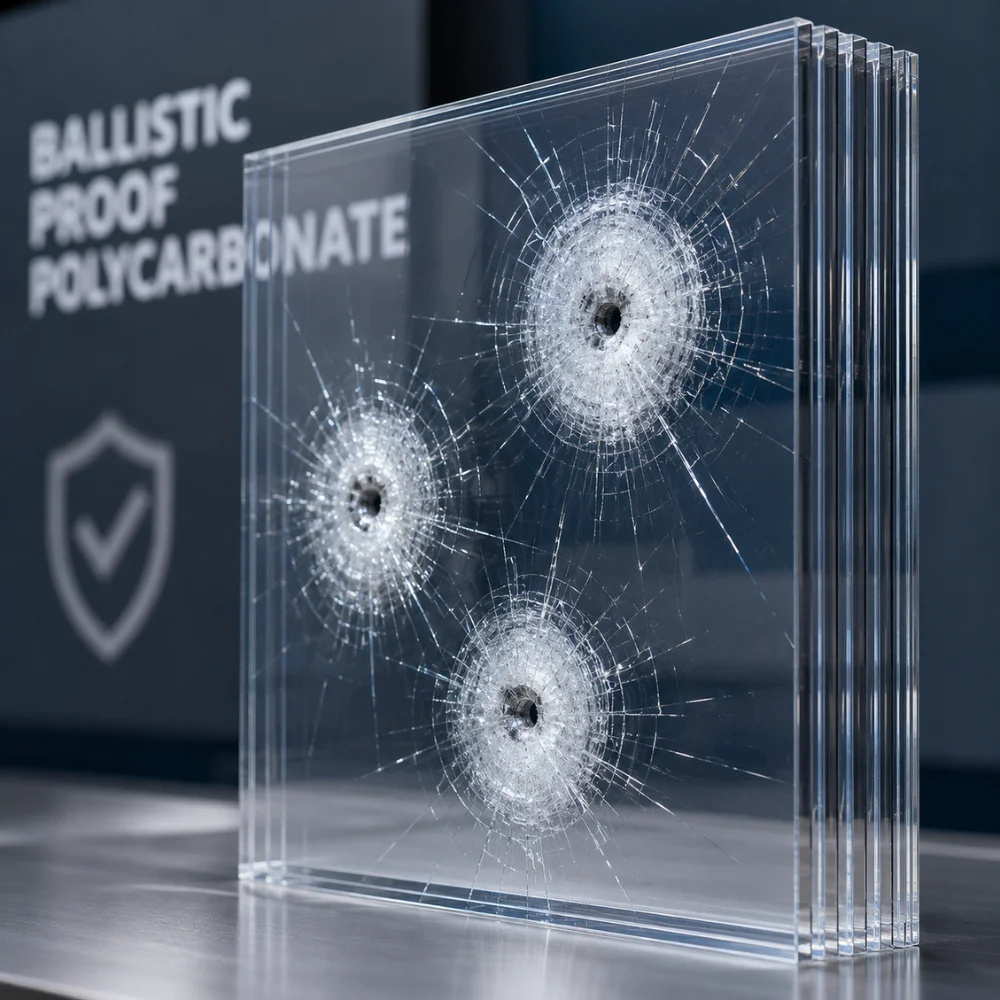
Ballistic Proof Polycarbonate is a high-security transparent glazing material engineered to provide exceptional impact resistance and protection against ballistic threats when incorporated into certified glazing systems. Manufactured from multiple layers of polycarbonate or laminated polycarbonate constructions, it is widely used in banks, government facilities, police stations, correctional centres, military installations, cash-handling areas and other high-security environments requiring maximum protection with excellent optical clarity.
Contact us for pricing
Description
Ballistic Proof Polycarbonate
Ballistic Proof Polycarbonate is a specialised high-security transparent glazing material engineered for applications requiring exceptional impact resistance and ballistic protection. Manufactured using advanced polycarbonate technology and, where required, multi-layer laminated constructions, it provides outstanding protection while maintaining excellent optical clarity and significantly reducing the risk of dangerous fragmentation.
Unlike conventional glass, ballistic polycarbonate is designed to absorb and dissipate the energy generated by projectile impacts. Its lightweight construction, exceptional toughness and superior impact resistance make it an ideal choice for high-security environments where personnel, property and critical infrastructure require enhanced protection.
Ballistic Proof Polycarbonate is commonly incorporated into certified security glazing systems for banks, correctional facilities, government buildings, military installations, police stations, embassies, cash-handling facilities and secure commercial environments. Depending on the project requirements, glazing systems can be designed to comply with recognised ballistic standards such as UL 752, EN 1063 or NIJ performance classifications.
Key Features & Common Applications
Key Features
|
Common Applications
|
Ballistic Proof Polycarbonate provides exceptional protection while maintaining clear visibility, making it one of the most effective transparent security glazing solutions available for high-risk environments.
Typical Ballistic Protection Levels
| Typical Standard | Typical Application |
|---|---|
| UL 752 | Banks, government buildings, security counters and cash transaction windows. |
| EN 1063 | Commercial security glazing, embassies, public buildings and secure facilities. |
| NIJ | Law enforcement, tactical applications and specialised security installations. |
Protection level, glazing thickness and construction vary according to the required threat level and applicable project specification.
Product Benefits
| Feature | Benefit |
|---|---|
| Ballistic Resistance | Provides protection against specified ballistic threats when incorporated into certified glazing systems. |
| High Impact Strength | Offers exceptional resistance to impact, forced entry and vandalism. |
| Optical Clarity | Maintains excellent visibility for security personnel and occupants. |
| Lightweight Construction | Easier to transport and install compared with equivalent laminated glass systems. |
| Fragment Retention | Helps reduce dangerous flying fragments after severe impact. |
| Custom Security Solutions | Available in project-specific sizes, thicknesses and certified glazing constructions. |
Important Specification Information
Ballistic performance is determined by the complete glazing system, including the polycarbonate construction, laminate configuration, frame design, fixing method and installation. Ballistic Proof Polycarbonate should always be specified and installed as part of a tested and certified glazing assembly appropriate for the required threat level.
Certification requirements vary according to the project and applicable standards. Final product selection should be based on the required ballistic classification, environmental conditions and project-specific security requirements.
Available Sizes & Thicknesses
Ballistic Proof Polycarbonate is available in a variety of thicknesses, laminate constructions and custom panel sizes depending on the required level of protection. Project-specific glazing systems can be manufactured to suit new installations, retrofits and specialised security applications.
Frequently Asked Questions
Find answers to common questions about HYGARD® BR750 and BR1250 ballistic-resistant polycarbonate glazing, including construction, ballistic ratings, forestry applications, installation, fabrication, outdoor use, cleaning and product selection.
HYGARD BR750 and HYGARD BR1250 are transparent, multi-layer security glazing laminates manufactured by Plaskolite. They combine layers of high-optical-quality TUFFAK® polycarbonate—or polycarbonate and acrylic—with polyurethane bonding interlayers.
Both surfaces incorporate Plaskolite’s proprietary TUFFAK abrasion-resistant hard coating, which improves resistance to scratching, chemical exposure, graffiti and weathering.
HYGARD laminates are manufactured by bonding several transparent sheets together with polyurethane interlayers:
- HYGARD BR750 is a three-ply laminate with abrasion-resistant TUFFAK polycarbonate surfaces and an acrylic core.
- HYGARD BR1250 is a four-ply, all-polycarbonate laminate with abrasion-resistant TUFFAK surfaces.
This multi-layer construction absorbs and distributes impact energy while maintaining visibility through the glazing.
| Property | HYGARD BR750 | HYGARD BR1250 |
|---|---|---|
| Construction | Three-ply polycarbonate/acrylic laminate | Four-ply all-polycarbonate laminate |
| Published thickness | Approximately 19.8 mm | Approximately 33 mm |
| Published weight | Approximately 24.9 kg/m² | Approximately 39.5 kg/m² |
| Light transmission | Approximately 88% | Approximately 72% |
| Ballistic rating | UL 752 Level 1 | UL 752 Level 3 |
| Tested ballistic threat | Specified 9 mm handgun round | Specified .44 Magnum handgun round |
| Additional ratings | Refer to current test certificate | NIJ Levels II and IIIA and specified forced-entry ratings |
These values are typical manufacturer-published properties and should not be used as the project specification without checking the current technical data and test certificates.
The correct term is bullet-resistant, not bulletproof.
HYGARD BR750 and BR1250 have been tested against specific ammunition, velocities, shot patterns and laboratory conditions. Their ratings must not be extended to other weapons or threats that are not covered by the relevant test report.
HYGARD BR750 is rated to UL 752 Level 1 for a specified 9 mm handgun threat. HYGARD BR1250 is rated to UL 752 Level 3 for a specified .44 Magnum handgun threat. UL 752 Level 3 is not a rifle-resistance rating.
The complete glazing system—including the laminate, frame, edge engagement, fixings, gaskets and supporting structure—must provide the required level of protection.
Unlike glazing containing conventional glass layers, HYGARD is designed to avoid hazardous glass fragments. Plaskolite states that its HYGARD laminates resist spalling and white-out, helping maintain visibility following repeated high-force impacts.
This is particularly important in security applications where staff must continue observing a threat after the glazing has been attacked. Plaskolite specifically identifies this benefit for the all-polycarbonate HYGARD BR1250 construction.
Typical applications include:
- Forestry machinery and heavy-equipment operator cabins
- Mining and earthmoving equipment glazing
- Government and defence facilities
- Police stations and secure control rooms
- Prisons, correctional facilities and detention centres
- Banks and financial institutions
- Security doors and observation windows
- Cash transaction and teller windows
- Convenience stores and specialty retailers
- Embassies and critical infrastructure
- Protective partitions and security screens
- High-risk reception and customer-service counters
Yes. HYGARD laminate may be considered for operator-cabin glazing in forestry machinery where high-impact protection, abrasion resistance and clear visibility are required. Potential applications include windscreens, cabin doors, side windows and rear windows in:
- Harvesters
- Forwarders
- Feller bunchers
- Skidders
- Mulchers and woodchippers
- Log loaders
- Excavators fitted with forestry attachments
- Other heavy forestry machinery
Its hard-coated surface helps protect the glazing from branches, wood debris, dirt, chemicals and frequent cleaning. HYGARD laminates are also substantially lighter than comparable glass security laminates, which may reduce the load placed on doors, hinges and cabin structures.
However, a ballistic rating does not automatically establish compliance with forestry saw-chain-shot, falling-object or machine-specific glazing requirements. The complete window and retention system must be assessed against the applicable forestry standard, machine manufacturer’s requirements and site risk assessment.
The correct grade depends on the identified hazard rather than thickness alone.
HYGARD BR750 provides high light transmission and lower weight while offering UL 752 Level 1 ballistic protection. HYGARD BR1250 provides a higher ballistic and forced-entry protection level, but it is thicker, heavier and transmits less light.
Before selecting either product, consider:
- Expected impact or projectile hazard
- Whether saw-chain-shot protection is required
- Required forestry or machinery standard
- Window dimensions and unsupported span
- Existing frame strength and glazing-channel depth
- Operator visibility requirements
- Door, hinge and cabin weight limitations
- Whether the window is flat or curved
- Environmental and cleaning conditions
Altius Polymers can review the application drawings and required test standard before recommending a grade.
HYGARD BR1250 carries manufacturer-published forced-entry and containment ratings, including ASTM F1233 and ASTM F1915 classifications. This makes it suitable for selected applications requiring both ballistic and physical-attack resistance.
HYGARD BR750’s cited product data primarily identifies its UL 752 Level 1 ballistic performance. It should not be represented as having the same forced-entry rating as BR1250 unless supported by the applicable test certificate.
HYGARD can replace glass security glazing in many new-build and retrofit applications, but it should not be treated as an automatic like-for-like replacement.
The existing frame must be checked for:
- Glazing-channel depth
- Required edge engagement
- Thermal expansion clearance
- Structural and impact loads
- Compatible setting blocks, gaskets and sealants
- Retention strength under the specified threat
- Additional thickness and panel weight
Plaskolite states that HYGARD laminates can be approximately 50% lighter than comparable glass laminates, potentially simplifying installation and reducing structural loads.
HYGARD must be installed as part of a properly engineered security glazing system. Plaskolite recommends:
- A structural frame with a security rating equal to or greater than the selected HYGARD grade
- At least 25.4 mm edge engagement around the laminate
- Sufficient frame depth to accommodate thermal expansion
- Polycarbonate-compatible wet sealants or dry gaskets
- Suitable setting blocks and continuous support
- Protection of all fabricated edges from moisture and incompatible chemicals
A ballistic-rated sheet installed in an inadequate frame does not create a fully ballistic-rated window.
Yes. HYGARD laminates can be professionally cut, routed and machined using suitable carbide-tipped tools and controlled fabrication procedures.
Plaskolite does not recommend laser cutting or waterjet cutting because these processes can increase stress, discolour the edges or cause delamination. Holes should generally be avoided in parts intended to retain a ballistic rating. Countersinking and solvent polishing are also not recommended.
Altius Polymers can provide cut-to-size and custom fabrication services based on approved drawings. Any fabrication must preserve the required edge engagement and glazing performance.
Plaskolite identifies the HYGARD BR range for indoor and outdoor applications. The exterior surfaces have a proprietary TUFFAK AR hard coating that helps resist abrasion, chemicals, graffiti and yellowing.
Cut edges do not have the same protective hard coating as the sheet faces. They must therefore be correctly enclosed or sealed within a compatible glazing system, particularly in outdoor, mining and forestry applications.
Pre-rinse the surface with clean lukewarm water to remove loose dirt, grit and forestry debris. Wash gently using diluted mild soap and a soft microfibre cloth or non-abrasive sponge, then rinse thoroughly and dry with a clean soft cloth.
Do not use:
- Abrasive cleaners or scouring pads
- Scrapers, razors or hard squeegees
- Ammonia-based or strongly alkaline cleaners
- Unapproved solvents
- Dry rubbing on a dusty surface
Do not attempt to buff scratches from the abrasion-resistant coating, as this can permanently damage the coating and distort the glazing.
Plaskolite publishes a seven-year limited product warranty for HYGARD BR750 and BR1250 against coating failure, yellowing and hazing. Warranty coverage is subject to Plaskolite’s current terms, approved fabrication, correct installation, compatible cleaning products and suitable application conditions.
To obtain an accurate recommendation or quotation, provide Altius Polymers with:
- Required ballistic, forced-entry or forestry protection standard
- Identified threat or impact hazard
- Finished window dimensions and quantity
- Flat or curved glazing requirement
- Existing frame drawings and glazing-channel dimensions
- Required edge engagement
- Indoor or outdoor exposure
- Machine make and model for forestry applications
- Required holes, cut-outs or special machining
- Required colour or tint
- Cleaning chemicals used on site
For Australian security projects, provide the nominated Australian or international standard. Altius Polymers can then confirm whether the required current test documentation is available for the exact HYGARD grade and glazing construction.
Ballistic Proof Polycarbonate
Ballistic Proof Polycarbonate is a specialised high-security transparent glazing material engineered for applications requiring exceptional impact resistance and ballistic protection. Manufactured using advanced polycarbonate technology and, where required, multi-layer laminated constructions, it provides outstanding protection while maintaining excellent optical clarity and significantly reducing the risk of dangerous fragmentation.
Unlike conventional glass, ballistic polycarbonate is designed to absorb and dissipate the energy generated by projectile impacts. Its lightweight construction, exceptional toughness and superior impact resistance make it an ideal choice for high-security environments where personnel, property and critical infrastructure require enhanced protection.
Ballistic Proof Polycarbonate is commonly incorporated into certified security glazing systems for banks, correctional facilities, government buildings, military installations, police stations, embassies, cash-handling facilities and secure commercial environments. Depending on the project requirements, glazing systems can be designed to comply with recognised ballistic standards such as UL 752, EN 1063 or NIJ performance classifications.
Key Features & Common Applications
Key Features
|
Common Applications
|
Ballistic Proof Polycarbonate provides exceptional protection while maintaining clear visibility, making it one of the most effective transparent security glazing solutions available for high-risk environments.
Typical Ballistic Protection Levels
| Typical Standard | Typical Application |
|---|---|
| UL 752 | Banks, government buildings, security counters and cash transaction windows. |
| EN 1063 | Commercial security glazing, embassies, public buildings and secure facilities. |
| NIJ | Law enforcement, tactical applications and specialised security installations. |
Protection level, glazing thickness and construction vary according to the required threat level and applicable project specification.
Product Benefits
| Feature | Benefit |
|---|---|
| Ballistic Resistance | Provides protection against specified ballistic threats when incorporated into certified glazing systems. |
| High Impact Strength | Offers exceptional resistance to impact, forced entry and vandalism. |
| Optical Clarity | Maintains excellent visibility for security personnel and occupants. |
| Lightweight Construction | Easier to transport and install compared with equivalent laminated glass systems. |
| Fragment Retention | Helps reduce dangerous flying fragments after severe impact. |
| Custom Security Solutions | Available in project-specific sizes, thicknesses and certified glazing constructions. |
Important Specification Information
Ballistic performance is determined by the complete glazing system, including the polycarbonate construction, laminate configuration, frame design, fixing method and installation. Ballistic Proof Polycarbonate should always be specified and installed as part of a tested and certified glazing assembly appropriate for the required threat level.
Certification requirements vary according to the project and applicable standards. Final product selection should be based on the required ballistic classification, environmental conditions and project-specific security requirements.
Available Sizes & Thicknesses
Ballistic Proof Polycarbonate is available in a variety of thicknesses, laminate constructions and custom panel sizes depending on the required level of protection. Project-specific glazing systems can be manufactured to suit new installations, retrofits and specialised security applications.
Frequently Asked Questions
Find answers to common questions about HYGARD® BR750 and BR1250 ballistic-resistant polycarbonate glazing, including construction, ballistic ratings, forestry applications, installation, fabrication, outdoor use, cleaning and product selection.
HYGARD BR750 and HYGARD BR1250 are transparent, multi-layer security glazing laminates manufactured by Plaskolite. They combine layers of high-optical-quality TUFFAK® polycarbonate—or polycarbonate and acrylic—with polyurethane bonding interlayers.
Both surfaces incorporate Plaskolite’s proprietary TUFFAK abrasion-resistant hard coating, which improves resistance to scratching, chemical exposure, graffiti and weathering.
HYGARD laminates are manufactured by bonding several transparent sheets together with polyurethane interlayers:
- HYGARD BR750 is a three-ply laminate with abrasion-resistant TUFFAK polycarbonate surfaces and an acrylic core.
- HYGARD BR1250 is a four-ply, all-polycarbonate laminate with abrasion-resistant TUFFAK surfaces.
This multi-layer construction absorbs and distributes impact energy while maintaining visibility through the glazing.
| Property | HYGARD BR750 | HYGARD BR1250 |
|---|---|---|
| Construction | Three-ply polycarbonate/acrylic laminate | Four-ply all-polycarbonate laminate |
| Published thickness | Approximately 19.8 mm | Approximately 33 mm |
| Published weight | Approximately 24.9 kg/m² | Approximately 39.5 kg/m² |
| Light transmission | Approximately 88% | Approximately 72% |
| Ballistic rating | UL 752 Level 1 | UL 752 Level 3 |
| Tested ballistic threat | Specified 9 mm handgun round | Specified .44 Magnum handgun round |
| Additional ratings | Refer to current test certificate | NIJ Levels II and IIIA and specified forced-entry ratings |
These values are typical manufacturer-published properties and should not be used as the project specification without checking the current technical data and test certificates.
The correct term is bullet-resistant, not bulletproof.
HYGARD BR750 and BR1250 have been tested against specific ammunition, velocities, shot patterns and laboratory conditions. Their ratings must not be extended to other weapons or threats that are not covered by the relevant test report.
HYGARD BR750 is rated to UL 752 Level 1 for a specified 9 mm handgun threat. HYGARD BR1250 is rated to UL 752 Level 3 for a specified .44 Magnum handgun threat. UL 752 Level 3 is not a rifle-resistance rating.
The complete glazing system—including the laminate, frame, edge engagement, fixings, gaskets and supporting structure—must provide the required level of protection.
Unlike glazing containing conventional glass layers, HYGARD is designed to avoid hazardous glass fragments. Plaskolite states that its HYGARD laminates resist spalling and white-out, helping maintain visibility following repeated high-force impacts.
This is particularly important in security applications where staff must continue observing a threat after the glazing has been attacked. Plaskolite specifically identifies this benefit for the all-polycarbonate HYGARD BR1250 construction.
Typical applications include:
- Forestry machinery and heavy-equipment operator cabins
- Mining and earthmoving equipment glazing
- Government and defence facilities
- Police stations and secure control rooms
- Prisons, correctional facilities and detention centres
- Banks and financial institutions
- Security doors and observation windows
- Cash transaction and teller windows
- Convenience stores and specialty retailers
- Embassies and critical infrastructure
- Protective partitions and security screens
- High-risk reception and customer-service counters
Yes. HYGARD laminate may be considered for operator-cabin glazing in forestry machinery where high-impact protection, abrasion resistance and clear visibility are required. Potential applications include windscreens, cabin doors, side windows and rear windows in:
- Harvesters
- Forwarders
- Feller bunchers
- Skidders
- Mulchers and woodchippers
- Log loaders
- Excavators fitted with forestry attachments
- Other heavy forestry machinery
Its hard-coated surface helps protect the glazing from branches, wood debris, dirt, chemicals and frequent cleaning. HYGARD laminates are also substantially lighter than comparable glass security laminates, which may reduce the load placed on doors, hinges and cabin structures.
However, a ballistic rating does not automatically establish compliance with forestry saw-chain-shot, falling-object or machine-specific glazing requirements. The complete window and retention system must be assessed against the applicable forestry standard, machine manufacturer’s requirements and site risk assessment.
The correct grade depends on the identified hazard rather than thickness alone.
HYGARD BR750 provides high light transmission and lower weight while offering UL 752 Level 1 ballistic protection. HYGARD BR1250 provides a higher ballistic and forced-entry protection level, but it is thicker, heavier and transmits less light.
Before selecting either product, consider:
- Expected impact or projectile hazard
- Whether saw-chain-shot protection is required
- Required forestry or machinery standard
- Window dimensions and unsupported span
- Existing frame strength and glazing-channel depth
- Operator visibility requirements
- Door, hinge and cabin weight limitations
- Whether the window is flat or curved
- Environmental and cleaning conditions
Altius Polymers can review the application drawings and required test standard before recommending a grade.
HYGARD BR1250 carries manufacturer-published forced-entry and containment ratings, including ASTM F1233 and ASTM F1915 classifications. This makes it suitable for selected applications requiring both ballistic and physical-attack resistance.
HYGARD BR750’s cited product data primarily identifies its UL 752 Level 1 ballistic performance. It should not be represented as having the same forced-entry rating as BR1250 unless supported by the applicable test certificate.
HYGARD can replace glass security glazing in many new-build and retrofit applications, but it should not be treated as an automatic like-for-like replacement.
The existing frame must be checked for:
- Glazing-channel depth
- Required edge engagement
- Thermal expansion clearance
- Structural and impact loads
- Compatible setting blocks, gaskets and sealants
- Retention strength under the specified threat
- Additional thickness and panel weight
Plaskolite states that HYGARD laminates can be approximately 50% lighter than comparable glass laminates, potentially simplifying installation and reducing structural loads.
HYGARD must be installed as part of a properly engineered security glazing system. Plaskolite recommends:
- A structural frame with a security rating equal to or greater than the selected HYGARD grade
- At least 25.4 mm edge engagement around the laminate
- Sufficient frame depth to accommodate thermal expansion
- Polycarbonate-compatible wet sealants or dry gaskets
- Suitable setting blocks and continuous support
- Protection of all fabricated edges from moisture and incompatible chemicals
A ballistic-rated sheet installed in an inadequate frame does not create a fully ballistic-rated window.
Yes. HYGARD laminates can be professionally cut, routed and machined using suitable carbide-tipped tools and controlled fabrication procedures.
Plaskolite does not recommend laser cutting or waterjet cutting because these processes can increase stress, discolour the edges or cause delamination. Holes should generally be avoided in parts intended to retain a ballistic rating. Countersinking and solvent polishing are also not recommended.
Altius Polymers can provide cut-to-size and custom fabrication services based on approved drawings. Any fabrication must preserve the required edge engagement and glazing performance.
Plaskolite identifies the HYGARD BR range for indoor and outdoor applications. The exterior surfaces have a proprietary TUFFAK AR hard coating that helps resist abrasion, chemicals, graffiti and yellowing.
Cut edges do not have the same protective hard coating as the sheet faces. They must therefore be correctly enclosed or sealed within a compatible glazing system, particularly in outdoor, mining and forestry applications.
Pre-rinse the surface with clean lukewarm water to remove loose dirt, grit and forestry debris. Wash gently using diluted mild soap and a soft microfibre cloth or non-abrasive sponge, then rinse thoroughly and dry with a clean soft cloth.
Do not use:
- Abrasive cleaners or scouring pads
- Scrapers, razors or hard squeegees
- Ammonia-based or strongly alkaline cleaners
- Unapproved solvents
- Dry rubbing on a dusty surface
Do not attempt to buff scratches from the abrasion-resistant coating, as this can permanently damage the coating and distort the glazing.
Plaskolite publishes a seven-year limited product warranty for HYGARD BR750 and BR1250 against coating failure, yellowing and hazing. Warranty coverage is subject to Plaskolite’s current terms, approved fabrication, correct installation, compatible cleaning products and suitable application conditions.
To obtain an accurate recommendation or quotation, provide Altius Polymers with:
- Required ballistic, forced-entry or forestry protection standard
- Identified threat or impact hazard
- Finished window dimensions and quantity
- Flat or curved glazing requirement
- Existing frame drawings and glazing-channel dimensions
- Required edge engagement
- Indoor or outdoor exposure
- Machine make and model for forestry applications
- Required holes, cut-outs or special machining
- Required colour or tint
- Cleaning chemicals used on site
For Australian security projects, provide the nominated Australian or international standard. Altius Polymers can then confirm whether the required current test documentation is available for the exact HYGARD grade and glazing construction.
 Overview
Specification
Overview
Description
Ballistic Proof Polycarbonate
Ballistic Proof Polycarbonate is a specialised high-security transparent glazing material engineered for applications requiring exceptional impact resistance and ballistic protection. Manufactured using advanced polycarbonate technology and, where required, multi-layer laminated constructions, it provides outstanding protection while maintaining excellent optical clarity and significantly reducing the risk of dangerous fragmentation.
Unlike conventional glass, ballistic polycarbonate is designed to absorb and dissipate the energy generated by projectile impacts. Its lightweight construction, exceptional toughness and superior impact resistance make it an ideal choice for high-security environments where personnel, property and critical infrastructure require enhanced protection.
Ballistic Proof Polycarbonate is commonly incorporated into certified security glazing systems for banks, correctional facilities, government buildings, military installations, police stations, embassies, cash-handling facilities and secure commercial environments. Depending on the project requirements, glazing systems can be designed to comply with recognised ballistic standards such as UL 752, EN 1063 or NIJ performance classifications.
Key Features & Common Applications
Key Features
|
Common Applications
|
Ballistic Proof Polycarbonate provides exceptional protection while maintaining clear visibility, making it one of the most effective transparent security glazing solutions available for high-risk environments.
Typical Ballistic Protection Levels
| Typical Standard | Typical Application |
|---|---|
| UL 752 | Banks, government buildings, security counters and cash transaction windows. |
| EN 1063 | Commercial security glazing, embassies, public buildings and secure facilities. |
| NIJ | Law enforcement, tactical applications and specialised security installations. |
Protection level, glazing thickness and construction vary according to the required threat level and applicable project specification.
Product Benefits
| Feature | Benefit |
|---|---|
| Ballistic Resistance | Provides protection against specified ballistic threats when incorporated into certified glazing systems. |
| High Impact Strength | Offers exceptional resistance to impact, forced entry and vandalism. |
| Optical Clarity | Maintains excellent visibility for security personnel and occupants. |
| Lightweight Construction | Easier to transport and install compared with equivalent laminated glass systems. |
| Fragment Retention | Helps reduce dangerous flying fragments after severe impact. |
| Custom Security Solutions | Available in project-specific sizes, thicknesses and certified glazing constructions. |
Important Specification Information
Ballistic performance is determined by the complete glazing system, including the polycarbonate construction, laminate configuration, frame design, fixing method and installation. Ballistic Proof Polycarbonate should always be specified and installed as part of a tested and certified glazing assembly appropriate for the required threat level.
Certification requirements vary according to the project and applicable standards. Final product selection should be based on the required ballistic classification, environmental conditions and project-specific security requirements.
Available Sizes & Thicknesses
Ballistic Proof Polycarbonate is available in a variety of thicknesses, laminate constructions and custom panel sizes depending on the required level of protection. Project-specific glazing systems can be manufactured to suit new installations, retrofits and specialised security applications.
Frequently Asked Questions
Find answers to common questions about HYGARD® BR750 and BR1250 ballistic-resistant polycarbonate glazing, including construction, ballistic ratings, forestry applications, installation, fabrication, outdoor use, cleaning and product selection.
HYGARD BR750 and HYGARD BR1250 are transparent, multi-layer security glazing laminates manufactured by Plaskolite. They combine layers of high-optical-quality TUFFAK® polycarbonate—or polycarbonate and acrylic—with polyurethane bonding interlayers.
Both surfaces incorporate Plaskolite’s proprietary TUFFAK abrasion-resistant hard coating, which improves resistance to scratching, chemical exposure, graffiti and weathering.
HYGARD laminates are manufactured by bonding several transparent sheets together with polyurethane interlayers:
- HYGARD BR750 is a three-ply laminate with abrasion-resistant TUFFAK polycarbonate surfaces and an acrylic core.
- HYGARD BR1250 is a four-ply, all-polycarbonate laminate with abrasion-resistant TUFFAK surfaces.
This multi-layer construction absorbs and distributes impact energy while maintaining visibility through the glazing.
| Property | HYGARD BR750 | HYGARD BR1250 |
|---|---|---|
| Construction | Three-ply polycarbonate/acrylic laminate | Four-ply all-polycarbonate laminate |
| Published thickness | Approximately 19.8 mm | Approximately 33 mm |
| Published weight | Approximately 24.9 kg/m² | Approximately 39.5 kg/m² |
| Light transmission | Approximately 88% | Approximately 72% |
| Ballistic rating | UL 752 Level 1 | UL 752 Level 3 |
| Tested ballistic threat | Specified 9 mm handgun round | Specified .44 Magnum handgun round |
| Additional ratings | Refer to current test certificate | NIJ Levels II and IIIA and specified forced-entry ratings |
These values are typical manufacturer-published properties and should not be used as the project specification without checking the current technical data and test certificates.
The correct term is bullet-resistant, not bulletproof.
HYGARD BR750 and BR1250 have been tested against specific ammunition, velocities, shot patterns and laboratory conditions. Their ratings must not be extended to other weapons or threats that are not covered by the relevant test report.
HYGARD BR750 is rated to UL 752 Level 1 for a specified 9 mm handgun threat. HYGARD BR1250 is rated to UL 752 Level 3 for a specified .44 Magnum handgun threat. UL 752 Level 3 is not a rifle-resistance rating.
The complete glazing system—including the laminate, frame, edge engagement, fixings, gaskets and supporting structure—must provide the required level of protection.
Unlike glazing containing conventional glass layers, HYGARD is designed to avoid hazardous glass fragments. Plaskolite states that its HYGARD laminates resist spalling and white-out, helping maintain visibility following repeated high-force impacts.
This is particularly important in security applications where staff must continue observing a threat after the glazing has been attacked. Plaskolite specifically identifies this benefit for the all-polycarbonate HYGARD BR1250 construction.
Typical applications include:
- Forestry machinery and heavy-equipment operator cabins
- Mining and earthmoving equipment glazing
- Government and defence facilities
- Police stations and secure control rooms
- Prisons, correctional facilities and detention centres
- Banks and financial institutions
- Security doors and observation windows
- Cash transaction and teller windows
- Convenience stores and specialty retailers
- Embassies and critical infrastructure
- Protective partitions and security screens
- High-risk reception and customer-service counters
Yes. HYGARD laminate may be considered for operator-cabin glazing in forestry machinery where high-impact protection, abrasion resistance and clear visibility are required. Potential applications include windscreens, cabin doors, side windows and rear windows in:
- Harvesters
- Forwarders
- Feller bunchers
- Skidders
- Mulchers and woodchippers
- Log loaders
- Excavators fitted with forestry attachments
- Other heavy forestry machinery
Its hard-coated surface helps protect the glazing from branches, wood debris, dirt, chemicals and frequent cleaning. HYGARD laminates are also substantially lighter than comparable glass security laminates, which may reduce the load placed on doors, hinges and cabin structures.
However, a ballistic rating does not automatically establish compliance with forestry saw-chain-shot, falling-object or machine-specific glazing requirements. The complete window and retention system must be assessed against the applicable forestry standard, machine manufacturer’s requirements and site risk assessment.
The correct grade depends on the identified hazard rather than thickness alone.
HYGARD BR750 provides high light transmission and lower weight while offering UL 752 Level 1 ballistic protection. HYGARD BR1250 provides a higher ballistic and forced-entry protection level, but it is thicker, heavier and transmits less light.
Before selecting either product, consider:
- Expected impact or projectile hazard
- Whether saw-chain-shot protection is required
- Required forestry or machinery standard
- Window dimensions and unsupported span
- Existing frame strength and glazing-channel depth
- Operator visibility requirements
- Door, hinge and cabin weight limitations
- Whether the window is flat or curved
- Environmental and cleaning conditions
Altius Polymers can review the application drawings and required test standard before recommending a grade.
HYGARD BR1250 carries manufacturer-published forced-entry and containment ratings, including ASTM F1233 and ASTM F1915 classifications. This makes it suitable for selected applications requiring both ballistic and physical-attack resistance.
HYGARD BR750’s cited product data primarily identifies its UL 752 Level 1 ballistic performance. It should not be represented as having the same forced-entry rating as BR1250 unless supported by the applicable test certificate.
HYGARD can replace glass security glazing in many new-build and retrofit applications, but it should not be treated as an automatic like-for-like replacement.
The existing frame must be checked for:
- Glazing-channel depth
- Required edge engagement
- Thermal expansion clearance
- Structural and impact loads
- Compatible setting blocks, gaskets and sealants
- Retention strength under the specified threat
- Additional thickness and panel weight
Plaskolite states that HYGARD laminates can be approximately 50% lighter than comparable glass laminates, potentially simplifying installation and reducing structural loads.
HYGARD must be installed as part of a properly engineered security glazing system. Plaskolite recommends:
- A structural frame with a security rating equal to or greater than the selected HYGARD grade
- At least 25.4 mm edge engagement around the laminate
- Sufficient frame depth to accommodate thermal expansion
- Polycarbonate-compatible wet sealants or dry gaskets
- Suitable setting blocks and continuous support
- Protection of all fabricated edges from moisture and incompatible chemicals
A ballistic-rated sheet installed in an inadequate frame does not create a fully ballistic-rated window.
Yes. HYGARD laminates can be professionally cut, routed and machined using suitable carbide-tipped tools and controlled fabrication procedures.
Plaskolite does not recommend laser cutting or waterjet cutting because these processes can increase stress, discolour the edges or cause delamination. Holes should generally be avoided in parts intended to retain a ballistic rating. Countersinking and solvent polishing are also not recommended.
Altius Polymers can provide cut-to-size and custom fabrication services based on approved drawings. Any fabrication must preserve the required edge engagement and glazing performance.
Plaskolite identifies the HYGARD BR range for indoor and outdoor applications. The exterior surfaces have a proprietary TUFFAK AR hard coating that helps resist abrasion, chemicals, graffiti and yellowing.
Cut edges do not have the same protective hard coating as the sheet faces. They must therefore be correctly enclosed or sealed within a compatible glazing system, particularly in outdoor, mining and forestry applications.
Pre-rinse the surface with clean lukewarm water to remove loose dirt, grit and forestry debris. Wash gently using diluted mild soap and a soft microfibre cloth or non-abrasive sponge, then rinse thoroughly and dry with a clean soft cloth.
Do not use:
- Abrasive cleaners or scouring pads
- Scrapers, razors or hard squeegees
- Ammonia-based or strongly alkaline cleaners
- Unapproved solvents
- Dry rubbing on a dusty surface
Do not attempt to buff scratches from the abrasion-resistant coating, as this can permanently damage the coating and distort the glazing.
Plaskolite publishes a seven-year limited product warranty for HYGARD BR750 and BR1250 against coating failure, yellowing and hazing. Warranty coverage is subject to Plaskolite’s current terms, approved fabrication, correct installation, compatible cleaning products and suitable application conditions.
To obtain an accurate recommendation or quotation, provide Altius Polymers with:
- Required ballistic, forced-entry or forestry protection standard
- Identified threat or impact hazard
- Finished window dimensions and quantity
- Flat or curved glazing requirement
- Existing frame drawings and glazing-channel dimensions
- Required edge engagement
- Indoor or outdoor exposure
- Machine make and model for forestry applications
- Required holes, cut-outs or special machining
- Required colour or tint
- Cleaning chemicals used on site
For Australian security projects, provide the nominated Australian or international standard. Altius Polymers can then confirm whether the required current test documentation is available for the exact HYGARD grade and glazing construction.
Review
Specification
Overview
 Processor
 Display
 RAM
RAM
Description
Ballistic Proof Polycarbonate
Ballistic Proof Polycarbonate is a specialised high-security transparent glazing material engineered for applications requiring exceptional impact resistance and ballistic protection. Manufactured using advanced polycarbonate technology and, where required, multi-layer laminated constructions, it provides outstanding protection while maintaining excellent optical clarity and significantly reducing the risk of dangerous fragmentation.
Unlike conventional glass, ballistic polycarbonate is designed to absorb and dissipate the energy generated by projectile impacts. Its lightweight construction, exceptional toughness and superior impact resistance make it an ideal choice for high-security environments where personnel, property and critical infrastructure require enhanced protection.
Ballistic Proof Polycarbonate is commonly incorporated into certified security glazing systems for banks, correctional facilities, government buildings, military installations, police stations, embassies, cash-handling facilities and secure commercial environments. Depending on the project requirements, glazing systems can be designed to comply with recognised ballistic standards such as UL 752, EN 1063 or NIJ performance classifications.
Key Features & Common Applications
Key Features
|
Common Applications
|
Ballistic Proof Polycarbonate provides exceptional protection while maintaining clear visibility, making it one of the most effective transparent security glazing solutions available for high-risk environments.
Typical Ballistic Protection Levels
| Typical Standard | Typical Application |
|---|---|
| UL 752 | Banks, government buildings, security counters and cash transaction windows. |
| EN 1063 | Commercial security glazing, embassies, public buildings and secure facilities. |
| NIJ | Law enforcement, tactical applications and specialised security installations. |
Protection level, glazing thickness and construction vary according to the required threat level and applicable project specification.
Product Benefits
| Feature | Benefit |
|---|---|
| Ballistic Resistance | Provides protection against specified ballistic threats when incorporated into certified glazing systems. |
| High Impact Strength | Offers exceptional resistance to impact, forced entry and vandalism. |
| Optical Clarity | Maintains excellent visibility for security personnel and occupants. |
| Lightweight Construction | Easier to transport and install compared with equivalent laminated glass systems. |
| Fragment Retention | Helps reduce dangerous flying fragments after severe impact. |
| Custom Security Solutions | Available in project-specific sizes, thicknesses and certified glazing constructions. |
Important Specification Information
Ballistic performance is determined by the complete glazing system, including the polycarbonate construction, laminate configuration, frame design, fixing method and installation. Ballistic Proof Polycarbonate should always be specified and installed as part of a tested and certified glazing assembly appropriate for the required threat level.
Certification requirements vary according to the project and applicable standards. Final product selection should be based on the required ballistic classification, environmental conditions and project-specific security requirements.
Available Sizes & Thicknesses
Ballistic Proof Polycarbonate is available in a variety of thicknesses, laminate constructions and custom panel sizes depending on the required level of protection. Project-specific glazing systems can be manufactured to suit new installations, retrofits and specialised security applications.
Frequently Asked Questions
Find answers to common questions about HYGARD® BR750 and BR1250 ballistic-resistant polycarbonate glazing, including construction, ballistic ratings, forestry applications, installation, fabrication, outdoor use, cleaning and product selection.
HYGARD BR750 and HYGARD BR1250 are transparent, multi-layer security glazing laminates manufactured by Plaskolite. They combine layers of high-optical-quality TUFFAK® polycarbonate—or polycarbonate and acrylic—with polyurethane bonding interlayers.
Both surfaces incorporate Plaskolite’s proprietary TUFFAK abrasion-resistant hard coating, which improves resistance to scratching, chemical exposure, graffiti and weathering.
HYGARD laminates are manufactured by bonding several transparent sheets together with polyurethane interlayers:
- HYGARD BR750 is a three-ply laminate with abrasion-resistant TUFFAK polycarbonate surfaces and an acrylic core.
- HYGARD BR1250 is a four-ply, all-polycarbonate laminate with abrasion-resistant TUFFAK surfaces.
This multi-layer construction absorbs and distributes impact energy while maintaining visibility through the glazing.
| Property | HYGARD BR750 | HYGARD BR1250 |
|---|---|---|
| Construction | Three-ply polycarbonate/acrylic laminate | Four-ply all-polycarbonate laminate |
| Published thickness | Approximately 19.8 mm | Approximately 33 mm |
| Published weight | Approximately 24.9 kg/m² | Approximately 39.5 kg/m² |
| Light transmission | Approximately 88% | Approximately 72% |
| Ballistic rating | UL 752 Level 1 | UL 752 Level 3 |
| Tested ballistic threat | Specified 9 mm handgun round | Specified .44 Magnum handgun round |
| Additional ratings | Refer to current test certificate | NIJ Levels II and IIIA and specified forced-entry ratings |
These values are typical manufacturer-published properties and should not be used as the project specification without checking the current technical data and test certificates.
The correct term is bullet-resistant, not bulletproof.
HYGARD BR750 and BR1250 have been tested against specific ammunition, velocities, shot patterns and laboratory conditions. Their ratings must not be extended to other weapons or threats that are not covered by the relevant test report.
HYGARD BR750 is rated to UL 752 Level 1 for a specified 9 mm handgun threat. HYGARD BR1250 is rated to UL 752 Level 3 for a specified .44 Magnum handgun threat. UL 752 Level 3 is not a rifle-resistance rating.
The complete glazing system—including the laminate, frame, edge engagement, fixings, gaskets and supporting structure—must provide the required level of protection.
Unlike glazing containing conventional glass layers, HYGARD is designed to avoid hazardous glass fragments. Plaskolite states that its HYGARD laminates resist spalling and white-out, helping maintain visibility following repeated high-force impacts.
This is particularly important in security applications where staff must continue observing a threat after the glazing has been attacked. Plaskolite specifically identifies this benefit for the all-polycarbonate HYGARD BR1250 construction.
Typical applications include:
- Forestry machinery and heavy-equipment operator cabins
- Mining and earthmoving equipment glazing
- Government and defence facilities
- Police stations and secure control rooms
- Prisons, correctional facilities and detention centres
- Banks and financial institutions
- Security doors and observation windows
- Cash transaction and teller windows
- Convenience stores and specialty retailers
- Embassies and critical infrastructure
- Protective partitions and security screens
- High-risk reception and customer-service counters
Yes. HYGARD laminate may be considered for operator-cabin glazing in forestry machinery where high-impact protection, abrasion resistance and clear visibility are required. Potential applications include windscreens, cabin doors, side windows and rear windows in:
- Harvesters
- Forwarders
- Feller bunchers
- Skidders
- Mulchers and woodchippers
- Log loaders
- Excavators fitted with forestry attachments
- Other heavy forestry machinery
Its hard-coated surface helps protect the glazing from branches, wood debris, dirt, chemicals and frequent cleaning. HYGARD laminates are also substantially lighter than comparable glass security laminates, which may reduce the load placed on doors, hinges and cabin structures.
However, a ballistic rating does not automatically establish compliance with forestry saw-chain-shot, falling-object or machine-specific glazing requirements. The complete window and retention system must be assessed against the applicable forestry standard, machine manufacturer’s requirements and site risk assessment.
The correct grade depends on the identified hazard rather than thickness alone.
HYGARD BR750 provides high light transmission and lower weight while offering UL 752 Level 1 ballistic protection. HYGARD BR1250 provides a higher ballistic and forced-entry protection level, but it is thicker, heavier and transmits less light.
Before selecting either product, consider:
- Expected impact or projectile hazard
- Whether saw-chain-shot protection is required
- Required forestry or machinery standard
- Window dimensions and unsupported span
- Existing frame strength and glazing-channel depth
- Operator visibility requirements
- Door, hinge and cabin weight limitations
- Whether the window is flat or curved
- Environmental and cleaning conditions
Altius Polymers can review the application drawings and required test standard before recommending a grade.
HYGARD BR1250 carries manufacturer-published forced-entry and containment ratings, including ASTM F1233 and ASTM F1915 classifications. This makes it suitable for selected applications requiring both ballistic and physical-attack resistance.
HYGARD BR750’s cited product data primarily identifies its UL 752 Level 1 ballistic performance. It should not be represented as having the same forced-entry rating as BR1250 unless supported by the applicable test certificate.
HYGARD can replace glass security glazing in many new-build and retrofit applications, but it should not be treated as an automatic like-for-like replacement.
The existing frame must be checked for:
- Glazing-channel depth
- Required edge engagement
- Thermal expansion clearance
- Structural and impact loads
- Compatible setting blocks, gaskets and sealants
- Retention strength under the specified threat
- Additional thickness and panel weight
Plaskolite states that HYGARD laminates can be approximately 50% lighter than comparable glass laminates, potentially simplifying installation and reducing structural loads.
HYGARD must be installed as part of a properly engineered security glazing system. Plaskolite recommends:
- A structural frame with a security rating equal to or greater than the selected HYGARD grade
- At least 25.4 mm edge engagement around the laminate
- Sufficient frame depth to accommodate thermal expansion
- Polycarbonate-compatible wet sealants or dry gaskets
- Suitable setting blocks and continuous support
- Protection of all fabricated edges from moisture and incompatible chemicals
A ballistic-rated sheet installed in an inadequate frame does not create a fully ballistic-rated window.
Yes. HYGARD laminates can be professionally cut, routed and machined using suitable carbide-tipped tools and controlled fabrication procedures.
Plaskolite does not recommend laser cutting or waterjet cutting because these processes can increase stress, discolour the edges or cause delamination. Holes should generally be avoided in parts intended to retain a ballistic rating. Countersinking and solvent polishing are also not recommended.
Altius Polymers can provide cut-to-size and custom fabrication services based on approved drawings. Any fabrication must preserve the required edge engagement and glazing performance.
Plaskolite identifies the HYGARD BR range for indoor and outdoor applications. The exterior surfaces have a proprietary TUFFAK AR hard coating that helps resist abrasion, chemicals, graffiti and yellowing.
Cut edges do not have the same protective hard coating as the sheet faces. They must therefore be correctly enclosed or sealed within a compatible glazing system, particularly in outdoor, mining and forestry applications.
Pre-rinse the surface with clean lukewarm water to remove loose dirt, grit and forestry debris. Wash gently using diluted mild soap and a soft microfibre cloth or non-abrasive sponge, then rinse thoroughly and dry with a clean soft cloth.
Do not use:
- Abrasive cleaners or scouring pads
- Scrapers, razors or hard squeegees
- Ammonia-based or strongly alkaline cleaners
- Unapproved solvents
- Dry rubbing on a dusty surface
Do not attempt to buff scratches from the abrasion-resistant coating, as this can permanently damage the coating and distort the glazing.
Plaskolite publishes a seven-year limited product warranty for HYGARD BR750 and BR1250 against coating failure, yellowing and hazing. Warranty coverage is subject to Plaskolite’s current terms, approved fabrication, correct installation, compatible cleaning products and suitable application conditions.
To obtain an accurate recommendation or quotation, provide Altius Polymers with:
- Required ballistic, forced-entry or forestry protection standard
- Identified threat or impact hazard
- Finished window dimensions and quantity
- Flat or curved glazing requirement
- Existing frame drawings and glazing-channel dimensions
- Required edge engagement
- Indoor or outdoor exposure
- Machine make and model for forestry applications
- Required holes, cut-outs or special machining
- Required colour or tint
- Cleaning chemicals used on site
For Australian security projects, provide the nominated Australian or international standard. Altius Polymers can then confirm whether the required current test documentation is available for the exact HYGARD grade and glazing construction.
Applications
Reviews
Clear filtersThere are no reviews yet.
You may also like



Reviews
Clear filtersThere are no reviews yet.